
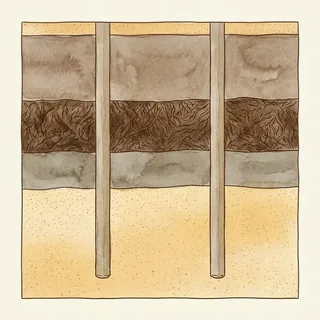
How a wooden pile foundation works
Timber piles transfer the building load through soft upper soil to deeper load-bearing layers. A ground beam or pile cap beam connects the piles to the walls above. The pile tip and pile head have different roles: tip capacity concerns structural support, while the pile-head level relative to groundwater affects the risk of fungal decay.
Foundation risks for wooden piles
Pile rot from low groundwater
Timber below groundwater is protected from the oxygen needed for fungal decay. If a pile head is repeatedly exposed to air, fungi can attack the wood. Whether this happens depends on the lowest groundwater level at the property and the actual pile-head level, not simply on the pile length.

Bacterial decay of timber piles
Some bacteria can degrade timber even below groundwater. Pine is particularly vulnerable in affected areas. This process is different from fungal decay caused by low groundwater, so raising groundwater is not a universal remedy for every form of pile deterioration.
Negative skin friction and insufficient pile capacity
When surrounding peat or clay settles, it can drag down along a pile. This negative skin friction adds load. Foundation settlement can also occur when pile tips do not reach a sufficiently load-bearing layer or when the original design no longer performs as required.
Signs of a failing wooden pile foundation
Diagonal cracks, sloping floors, sticking doors, distortion at a party wall and movement relative to neighbouring buildings can justify further investigation. None of these signs proves pile damage. A specialist must distinguish foundation movement from shrinkage, lintel defects, extensions and other causes.
Wooden pile foundation risks by city
Foundation types change within cities and sometimes within one street. The summaries below are area context, never a diagnosis for a property.
Amsterdam
Many homes built between 1880 and 1940 stand on timber piles through peat and clay. Pile length, sand depth and pile-head level vary by building block. Waternet manages groundwater levels, but a city-wide area picture cannot establish the condition of an individual foundation. Indische Buurt, De Pijp, Oud-Noord and Spaarndammerbuurt contain substantial stocks of pre-war piled buildings.
Rotterdam
Deep peat and soft clay occur across large parts of the city. Pre-war homes from roughly 1900 to 1940 may stand on spruce or pine piles. Relevant foundation risks include exposed pile heads, bacterial soft rot, negative skin friction and inadequate pile-tip capacity. Bospolder-Tussendijken, Oud-Charlois, Het Oude Westen and Crooswijk are municipal attention areas.
Haarlem
The old beach ridge creates a marked local divide. Firmer sand occurs to the west, where shallow foundations are common, while clay and peat to the east are associated with timber pile foundations. Rozenprieel, Leidsebuurt and Amsterdamse Buurt are recognised attention areas. The exact foundation still needs checking by address.
The Hague
Old beach ridges alternate with lower plains and channels containing peat and clay. Pre-war timber piles occur in the softer zones, while shallow foundations are more common on the ridges. A 2023 municipal study identified Schildersbuurt, Stationsbuurt and Bezuidenhout among the areas with comparatively greater foundation risks from low groundwater.
Utrecht
Foundation conditions differ sharply between neighbourhoods. Firmer sand lies closer to the surface in parts of eastern Utrecht, while soft peat and clay occur in western districts where timber piles are more common. Lombok, Pijlsweerd, Zeeheldenbuurt and Ondiep are local attention areas. Street-level archive data is more useful than a city average.
How to check a wooden pile foundation before buying
- Request foundation drawings, pile schedules and previous reports from the building archive and seller.
- Compare pile-head information with measured groundwater levels, where available.
- Review cracks, floor levels and movement across the full building block.
- Commission a specialist foundation survey, not only a structural survey, if the records or observed signs indicate material foundation risks.
- Use a CPT survey, or cone penetration test, when the ground profile and pile-tip capacity need further assessment.
Terminology: the Dutch term fundering op staal does not mean a steel foundation. It describes a shallow foundation bearing directly on sufficiently firm soil.
If the piles need replacing, the bill is substantial. See foundation repair costs in the Netherlands for current price ranges.
Sources and limits
Local summaries are based on the municipal and water-authority sources maintained on Fundering.help’s Dutch regional pages. Conditions vary per building block. An address check remains preliminary, while a foundation survey examines the property itself.